

How to Adjust Cabinet Doors Through Seasonal Changes
If you’ve ever noticed your cabinet doors shifting, rubbing, or sagging as the weather changes, you’re not imagining it. Cabinets, especially those made of wood, respond to the natural moisture in the air.
🌞 Summer: When Humidity Hits
In the warmer months, higher humidity levels cause wood to absorb moisture from the air. This can lead to:
- Swelling or expansion of cabinet doors and frames
- Doors that stick, rub, or won’t close smoothly
- Tighter gaps between doors
- Hinges that feel slightly off or under pressure
If your cabinets were installed in cooler, drier months, this sudden expansion in summer can make them feel like they’re out of alignment — even though they were fine just weeks ago.
❄️ Winter: Dry Air, Shrinking Wood
As temperatures drop and heaters kick on, indoor air becomes much drier. Wood reacts by releasing moisture, which can cause it to:
- Contract or shrink
- Leave visible gaps between cabinet doors or between the door and the frame
- Create a loose or uneven look
- Lead to slight warping or cupping in extreme dryness
These changes are completely natural but can be frustrating if you don’t expect them.
The good news? These seasonal shifts are totally normal — and often an easy fix. In most cases, all it takes is a simple adjustment to the cabinet hinges with a screwdriver. No need to replace doors or call in a professional — just a few small tweaks can get things looking and working like new again.
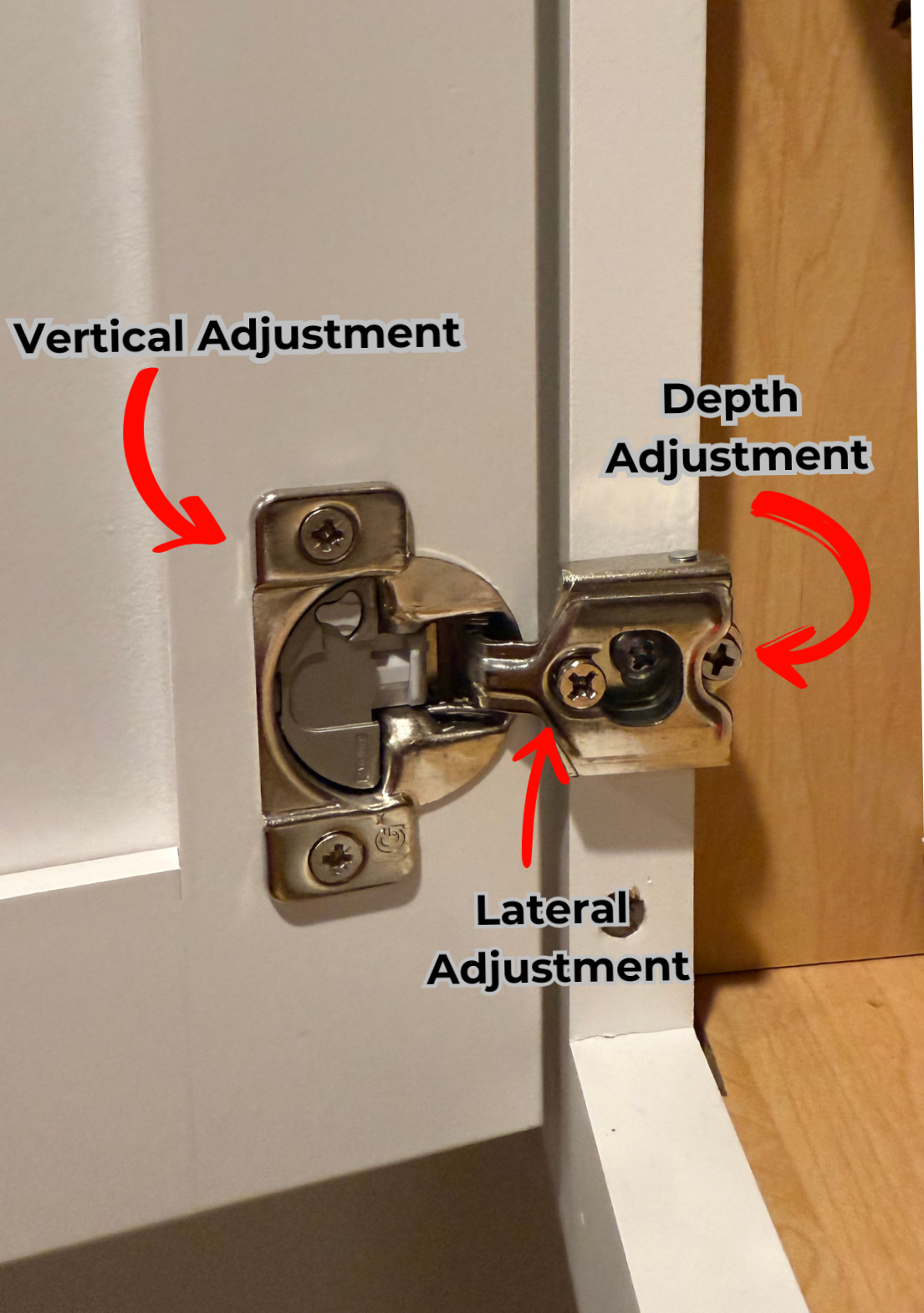
1. Depth (In‑and‑Out) Adjustment
What it does: Moves the door closer to or farther from the cabinet frame.
Signs you need it:
- The door scraping against the top or bottom of the frame
- A large gap between the door and face frame
How to fix it:
- Locate the depth screw—the one nearest the front edge on the hinge arm.
- Turn ¼ turn counterclockwise to move the door further into the cabinet (away from the front frame).
- Turn ¼ turn clockwise to bring the door closer to the frame if the gap is too wide.
- Test the door; repeat in small increments until movement is smooth.
2. Lateral (Side‑to‑Side) Adjustment
What it does: Shifts the door left or right to even outside gaps.
Signs you need it:
- Uneven gap between double doors or between a door and the cabinet side
- Door drifting toward one side when closed
How to fix it:
- Find the lateral screw—typically the middle one on the hinge arm.
- Turn ¼ turn clockwise to nudge the door toward the hinge side.
- Turn ¼ turn counter‑clockwise to pull it away.
- Aim for a consistent ⅛″–³⁄₁₆″ gap all around.
3. Vertical (Up‑and‑Down) Adjustment
What it does: Raises or lowers the entire door to match its neighbor.
Signs you need it:
- The door sits higher or lower than adjacent doors
- Noticeable gap at the top or bottom of the door
How to fix it:
- Loosen both screws on the mounting plate
- Lift or lower the door to the correct height
- Re‑tighten the screws evenly
- Check alignment and fine‑tune as needed
✅ Action Steps
- Complete the steps above to see if they resolve your cabinet concerns.
- If that solved the issue and you have an open Customer Service request with Patterson Company, email service@buypatterson.com to close the ticket.
- If not, a Patterson Company new home professional will reach out shortly with the next steps to address your Customer Service Request.


